Yalta, Shenzhen-Style ,or How Three Titans Saved the World
In Shenzhen, China—where skyscrapers pierce the clouds faster than diplomats can agree on a communiqué—an event took place that its participants immediately dubbed «historic.»
For the first time, three figures sat at the same round table on the sidelines of the APEC summit: the evening’s host Xi Jinping, chief connoisseur of loud headlines Donald Trump, and great admirer of historical reenactments Vladimir Putin.
The prelude to the banquet set the tone for the entire spectacle.
President Xi greeted his esteemed American guest at the airplane stairs personally—complete with a marching band, a red carpet, and a broad smile.
His Russian counterpart, meanwhile, got a fifth-tier official whose facial expression eloquently said, «Step along, please, don’t hold up the passport control line.»
To salvage his bruised grandeur, the guest from Moscow decided to stroll a little closer to the cameras with his nuclear briefcase.
It looked as though someone had shown up to a Michelin-starred dinner party with their own thermos and set it down in plain sight—just so everyone would know who else knew how to cook.
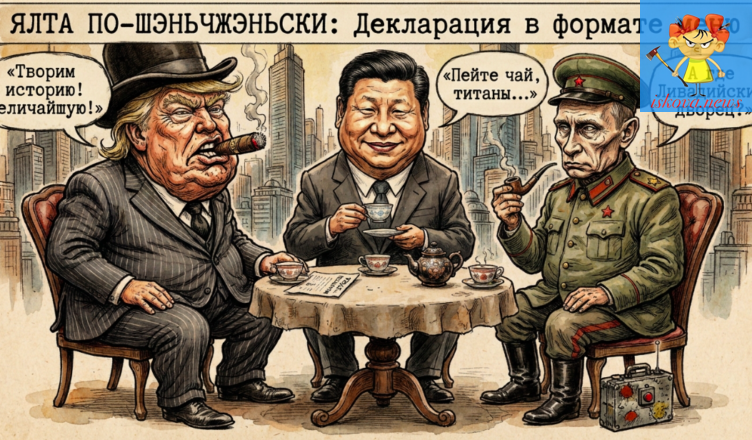
Inside the negotiating hall, the seating arrangement resembled a family portrait where an uncle from across the ocean and a neighbour from the north carefully pretend they aren’t dividing up the inheritance while the head of the household pours tea in the center.
Here, the summit’s central collective illusion came into full view: everyone at the table was mentally trying on a bronze uniform from 1945.
One saw Churchill’s cigar in the mirror, another saw Roosevelt’s stature, and the third saw Stalin’s pipe and generalissimo tunic.
The three politicians earnestly indulged in the fantasy of a new «Big Three,» believing a mere glance over a teacup would make the globe obediently spin in the right direction—even though it was a completely different century, and instead of a world map, they held nothing more than talking points for the evening news.
Right off the bat, Trump declared they were «making history» and called his Moscow counterpart a «friend.» With Confucian calm, Xi Jinping urged everyone to «abandon the Cold War mentality» and simply get along, while slipping in a reminder about sovereignty.
Putin visibly relished playing the arbiter of fate, as if the Livadia Palace were waiting just outside the conference room doors.
Yet instead of a new division of the world, an hour and a half later the public was presented with a document the size of a restaurant menu—a four-point «Declaration of Peace.»
It turned out that the newly minted «Churchill, Roosevelt, and Stalin» had gathered in southern China to promise not to blow up the planet (a remarkably fresh idea), scold the International Criminal Court for excessive curiosity, pledge to reform the UN, and—most importantly—boost deliveries of petroleum products.
As for the war in Ukraine, the very reason many had tuned in to watch this trio, not a single line made it into the final paper: apparently, it didn’t quite fit the format of a «historic breakthrough.»
The titans departed in splendid spirits.
Trump got the perfect photo op for social media, Xi cemented his status as the planet’s chief moderator, and Putin took home a group picture to air on state television in place of frontline reports.
Meanwhile, the rest of the world was left wondering: if this is what «writing history» looks like, wouldn’t it be better to just read the old textbooks instead?

Last Updated on 23.11.2026 by iskova