
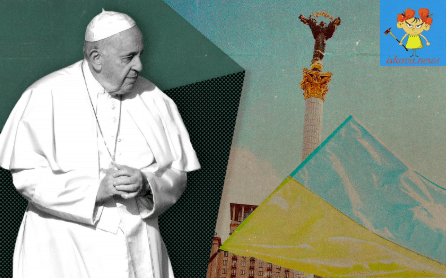
Realism of Mercy: Why the Vatican’s Initiatives Are a Strategic Resource for Kyiv ,Not «Concessions»
KYIV — As the diplomatic landscape surrounding the Russia-Ukraine war shifts rapidly, Kyiv faces intense maneuvers by global powers—ranging from high-stakes policy shifts in Washington to complex debates over a new security architecture for European stability.
In this environment, Ukraine must leverage every available tool of international influence.
One of the most underutilized yet strategically vital assets for the Office of the President and the Ministry of Foreign Affairs of Ukraine remains the Holy See.
For a long time, both Ukrainian society and government circles viewed the Vatican’s peace initiatives with a degree of skepticism, dismissing them as detached, idealistic pacifism. However, a close look at the Apostolic Palace’s official stance reveals the opposite: the Vatican’s «diplomacy of mercy» has transformed into a pragmatic tool that aligns directly with Ukraine’s long-term sovereign interests.
Expert Analysis: The End of «Ambiguity»
Ukrainian religious scholars and international relations analysts, who previously criticized the Holy See for its over-cautious diplomatic rhetoric during the early phases of the war, now point to a tectonic shift in the Vatican’s approach.
-
- A Paradigm of Defense, Not Passivity: Analysts emphasize that the Vatican’s position is shaped by a synergy of Church social doctrine, the classic tradition of Ostpolitik, the current pontiff’s personal philosophy, and strict adherence to international law. Experts underscore that when the Vatican’s Secretary of State, Cardinal Pietro Parolin, openly declared that the international community has no right to deny the Ukrainian people their legitimate right to self-defense, the Vatican decisively moved away from «absolute pacifism» [3181256.html]. The Holy See’s theological and political framework now directly legitimizes Ukraine’s right to defend its borders through armed force.
- Explicit Identification of the Aggressor: The Vatican has increasingly formalized the understanding that a lasting peace is impossible without drawing a clear line between the victim and the aggressor, and without full accountability under international humanitarian law. This clarity has been consistently reinforced during high-level engagements, including talks with Verkhovna Rada Speaker Ruslan Stefanchuk at the Apostolic Palace.
The Key to the Global South: The Vatican’s Geopolitical Leverage
One of Kyiv’s most complex diplomatic hurdles remains winning over the countries of the Global South (Latin America, Africa, and parts of Asia). In these macro-regions, traditional Western arguments often clash with deep-seated historical distrust and anti-colonial sentiment. This is where the Vatican holds a unique, almost monopoly advantage.

The Catholic Church functions as a global network connecting over 1.3 billion believers, a vast proportion of whom live within the Global South.
-
- Latin America: The voice of the Pope and the Curia carries unparalleled moral authority among the leadership and societies of nations like Brazil, Argentina, and Mexico. When the Holy See broadcasts messages about the impermissibility of violating Ukraine’s sovereignty, it effectively deconstructs Moscow’s narrative of a «NATO proxy war» in the eyes of Latin American elites.
- The African Continent: Through its extensive network of humanitarian and religious missions, the Vatican frames the aggression against Ukraine not as a distant European dispute, but as a direct threat to global food security and economic stability. For Kyiv, the Vatican’s backing serves as a potent soft-power channel, opening doors to capitals in the Global South that Ukrainian diplomats have struggled to engage directly.
Historical Precedent: The Mechanics of Papal Arbitration
For pragmatic policymakers in Kyiv, it is vital to recognize that the Vatican is not an academic debating club. It is the world’s oldest diplomatic institution with a proven track record of defusing seemingly intractable international crises. History shows the Holy See has successfully halted conflicts precisely when global powers and international bodies reached a deadlock:
-
- The Cuban Missile Crisis (1962): De-escalating Nuclear Brinkmanship
At the absolute peak of the nuclear standoff between the US and the USSR, Pope John XXIII served as a confidential, trusted intermediary between John F. Kennedy and Nikita Khrushchev. Utilizing a distinct model of moral public appeals combined with backchannel messages, the Pope’s public broadcast calling for historical courage provided both superpowers with the political off-ramp needed to back down without losing face. This intervention directly opened the path to the dismantling of Soviet missiles in Cuba and US missiles in Turkey. - The Beagle Channel Dispute (1978): Institutional Boundary Mediation
Argentina and Chile were on the brink of all-out war over a territorial dispute in the Beagle Channel. The direct mediation model of Pope John Paul II involved sending a highly empowered personal envoy, Cardinal Antonio Samorè, to the region. Samorè established a neutral «buffer zone of discussion» in Rome, shifting the conflict from military mobilization to legal and historical technicalities. This process successfully froze hostilities and led to the 1984 Treaty of Peace and Friendship, which permanently resolved the border issue. - The Cuban Thaw (2014): The «Discreet Facilitator» Model
The Holy See spent months moderating secret, parallel talks between Washington and Havana. Rather than acting as a traditional negotiator that dictates terms, the Vatican utilized the «Discreet Facilitator» model. Pope Francis sent personal, handwritten letters to Barack Obama and Raúl Castro to build basic trust, while the Vatican secretariat hosted closed-door delegations in Rome. This unique space allowed both nations to draft the framework that ultimately restored diplomatic relations after more than half a century of hostility. - Mozambique (1992): Non-Governmental Track-Two Diplomacy
With the active facilitation of the Community of Sant’Egidio—a lay Catholic movement closely tied to the Vatican—a brutal 16-year civil war that cost a million lives was brought to an end. This «Track-Two» diplomacy model bypassed rigid official state protocols. Rome provided a neutral, trusted, and non-threatening space where guerrilla leaders and government officials could sit as equals. Over 27 months of patient dialogue, this model transformed a military stalemate into a comprehensive peace agreement.
- The Cuban Missile Crisis (1962): De-escalating Nuclear Brinkmanship
Pragmatic Arguments: Why the Vatican’s Initiatives Benefit Kyiv
1. Moral Legitimization of the Resistance
The Holy See‘s explicit backing of Ukraine’s right to armed self-defense, articulated by Cardinal Parolin to major international media, strips Moscow’s propaganda of its moral veneer [3181256.html]. For the Ukrainian leadership, this provides an unassailable ethical argument when engaging with hesitant international partners.
2. The Exclusive Humanitarian Track of the Zuppi Mission
The shuttle diplomacy of the Pope’s special envoy, Cardinal Matteo Zuppi, who maintains a regular communication loop between Kyiv and Moscow, has proven irreplaceable. With traditional political talks completely frozen, the Zuppi mission operates as a viable channel for facilitating the exchange of POWs, severely wounded personnel, and detained civilians, as well as providing an independent channel for monitoring humanitarian conditions on the ground.
3. Uncompromising Stance on the Rule of International Law
The Vatican does not advocate for «peace at any cost» via the dismemberment of Ukraine. Archbishop Paul Richard Gallagher, the Holy See’s Foreign Minister, has consistently and firmly linked any long-term settlement to strict adherence to international law and respect for sovereign borders during direct communications with Russian representatives. The Vatican’s push for a revitalized European security architecture is an effort to solidify the impermissibility of territorial aggression within a renewed global consensus.
4. Rapid Crisis Intervention by the Pontiff
Direct interventions by the Pope, such as his urgent appeals for ceasefires to rescue trapped civilians in occupied and frontline areas (such as the town of Oleshky in the Kherson region), demonstrate the Vatican’s readiness to act dynamically on a micro-level. Kyiv can utilize this unique channel to de-escalate specific, acute humanitarian crises in occupied territories where the UN or the International Committee of the Red Cross (ICRC) find themselves paralyzed by bureaucratic or political barriers.
Comparative Analysis of Mediation Platforms
| Criterion | Mediation by Major Geopolitical Powers (e.g., US / China) | The Holy See’s Diplomacy (The Vatican) |
|---|---|---|
| Primary Motivation | Geopolitical leverage, economic dominance, domestic electoral cycles. | Humanitarian mission, preservation of life, stability of international law. |
| Access to the RF | Severely restricted or toxic; perceived by Moscow as an «existential adversary.» | Maintained working channels (Gallagher-Lavrov meetings, Zuppi’s visits). |
| Influence on Global South | Often viewed through the lens of neo-colonial pressure or economic alignment. | Holds immense institutional and moral authority across leadership elites. |
| Core Negotiation Focus | Territorial trade-offs, energy corridors, sanctions packages. | Repatriation of children, POW exchanges, civilian rescue in disaster zones. |
The View from Kyiv: Official Statements and the «Bring Kids Back UA» Project
Evidencing that Kyiv no longer views the Vatican as a passive bystander, top Ukrainian officials have increasingly integrated the Holy See into its core humanitarian operations.
A central pillar of this cooperation is Ukraine’s Bring Kids Back UA project, a unified presidential initiative designed to rescue, rehabilitate, and reintegrate thousands of Ukrainian children forcibly deported or unlawfully transferred by the Russian Federation.
The project relies heavily on the Vatican’s unique access to Moscow to overcome systemic deadlocks. Rather than using public, confrontational diplomacy, the Bring Kids Back UA team utilizes the Zuppi-Vatican channel to transmit verified data packages, confirm the identities and locations of children held in Russia, and arrange secure transit routes via third countries.
💬 "We highly appreciate the involvement of the Holy See.
Bringing our people home and rescuing children abducted by Russia
is an area where the Vatican's humanitarian mediation track shows real results.
The 'Bring Kids Back UA' initiative finds complete and unconditional support here."
— Andriy Yermak, Head of the Office of the President of Ukraine
(following coordination with Cardinal Parolin).
Ukrainian leaders place special emphasis on the fact that the Apostolic Palace’s mediation does not imply compromises on international law. Verkhovna Rada Speaker Ruslan Stefanchuk made this clear during his official visit to Rome:
💬 "Ukraine deeply values the Holy See's efforts aimed at helping
the families of our prisoners of war and returning Ukrainians home.
However, it remains fundamental for us that any peace initiatives
are anchored in international law and clearly distinguish between
 the aggressor and the victim of aggression.
 A just peace is simply impossible without this understanding."
— Ruslan Stefanchuk, Speaker of the Verkhovna Rada of Ukraine.
Stefanchuk also relayed an essential message from Cardinal Parolin reflecting the Vatican’s institutional position: «We feel the pain of the war in Ukraine. It pains us when international humanitarian law is violated and peaceful people die.»
The initiatives of the Holy See do not run counter to Ukraine’s «Peace Formula»—they serve as a practical toolkit to execute it where traditional diplomatic avenues hit a wall.
Harmonizing Ukraine’s defense strategy with the Vatican’s diplomatic potential offers Kyiv three distinct tactical advantages:
-
- A «Humanitarian Conduit» Free of Political Concessions:
By engaging in direct, backdoor humanitarian negotiations with Russia over prisoners or borders, Kyiv risks inadvertently legitimizing the Kremlin’s terms. Delegating these delicate tracks to Cardinal Zuppi’s mission and the Bring Kids Back UA framework mitigates this risk. The Vatican absorbs the political friction of communicating with Moscow, allowing Ukraine to recover its citizens while maintaining an ironclad public position: zero territorial compromises. - Breaking the Diplomatic Gridlock in the Global South:
The Vatican acts as an ideal «translator» for Ukraine. It frames Ukraine’s narrative of justice, sovereignty, and the protection of the vulnerable into the language of Christian ethics and anti-colonial law—concepts deeply understood in Latin America and Africa. Integrating the Vatican’s initiatives into Ukraine’s wider strategy deprives Russia of the ability to paint the conflict purely as a localized standoff between «the RF and NATO.» - Preempting the Peace Narrative and Securing Long-Term Stability:
If Kyiv sidelines the Vatican format, the Kremlin will inevitably attempt to hijack it, fabricating a desire for peace to court favor with the Catholic world. Active Ukrainian engagement in Vatican processes allows the Office of the President to help steer the conversation regarding Europe’s future security architecture toward a model built on strict international law, as advocated by Archbishop Gallagher. As noted by Stefanchuk, a major catalyst for this alignment remains the prospect of an Apostolic Visit by the Pope to Ukraine, which would serve as a powerful signal of global solidarity.
- A «Humanitarian Conduit» Free of Political Concessions:
The Bottom Line: Robust pragmatism dictates that the Ukrainian government treat the Vatican not as an abstract moral voice, but as a seasoned international arbiter. Capitalizing on its global authority, unique communication channels, and deep historical experience is a highly effective way to elevate Ukraine’s international standing, save lives, and pave the path toward a just and enduring peace.
Last Updated on 17.10.2026 by iskova