The Evolution of Human Cooperation (Or: How We Perfected the Art of Throwing Rocks)
Welcome, sophisticated primates, to a brief history of our absolute favourite, centuries-tested hobby: wholesale mutual destruction.
While other species wasted millions of years evolving complex ecosystems, human beings focused on truly practical questions. Questions like:
«That guy over there has a slightly drier cave than me. How hard do I need to hit him with this bone to change that?»
Let us trace this majestic and deeply logical timeline: from throwing primitive mud to splitting the atom. All in the name of peace, obviously.
The Stone Age: The Dawn of «Progress»
For a long time, naive anthropologists believed early humans lived in absolute harmony with nature, doing nothing but gathering daisies. Then we dug up Jebel Sahara in Sudan.
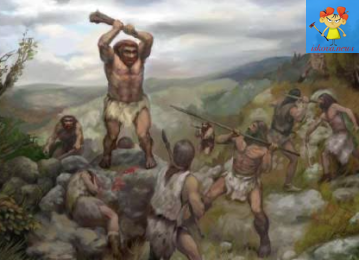
As it turns out, roughly 14,000 years ago, our ancestors were already enthusiastically embedding flint arrowheads into the skeletons of their neighbours.
The causes for these early geopolitical conflicts were truly monumental:
«You are foraging for berries on my side of the bush.»
«Your fire looks warmer than mine, share the cave (forever).»
There were no diplomatic notes of protest, no multi-vector global summits. Just pure, unadulterated passion and a heavy, blunt object.
Antiquity and The Middle Ages: Expanding the Brand
As humans evolved, we realized that fighting simply over berries was the domain of small-time shopkeepers. We needed narratives. Enter the era of great empires, noble estates, and divine right.
Why fight for a bush when you can destroy each other because a ruler wants his face stamped on more gold coins? Or better yet, because your neighbor prays to the same deity, but uses a different book and holds a slightly wrong expression while doing so?
We graduated to catapults, ballistas, steel swords, and the beautiful institution of chivalry—a lovely system where men in shining armor composed poetry for ladies and then elegantly trampled the fields of peasants who couldn’t afford proper clothing.
Progress is undeniable.
The 20th Century: The Industrialization of the Graveyard
Ah, the glorious 1900s. The century where humanity truly looked into the mirror and said, «We can do better.»
Why swing a sword manually when you can invent a machine gun that does all the work from a mile away?
We packaged our ancient grudges into neat, globally branded packages: World War I and World War II.
We began fighting for abstract «living space,» for flags, and for economic theories written by men with majestic beards in quiet libraries.
The crowning achievement of human intelligence became the nuclear bomb.
We grew so incredibly good at killing that we invented «Mutually Assured Destruction»—a system where we guarantee global security by promising to turn the entire planet into a lifeless desert if anyone on the other side of the ocean happens to flinch.
A flawless, foolproof plan.
The 21st Century: The Disgraceful Utopia of High Tech
And here we are today. The 21st century.
The era of unprecedented humanism, mindfulness, and oat milk lattes.
Everyone has a supercomputer in their pocket, our rovers are taking selfies on Mars, and world leaders sign climate declarations with straight faces at international forums.
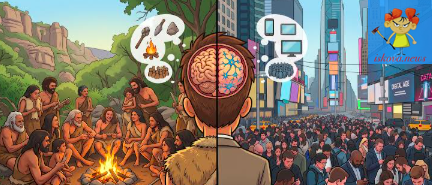
And yet, with the exact same passion, we continue to do exactly what we did 14,000 years ago.
Except now, this primal instinct is wrapped in expensive digital design and managed by political systems that have reached the absolute peak of absurdity.
Look at how gracefully we have reimagined warfare:
Architects of Crisis: The political elites of the 21st century have turned geopolitics into a cynical chessboard. On one side, we have leaders with messianic complexes who, from the safety of their offices, try to write themselves into school textbooks by paying for their historical insecurities with other people’s lives. On the other side are bureaucratic institutions capable of spending months debating the wording of resolutions and expressing «deepest concern» on social media, all while military-industrial complex factories break profit records.
Wars are no longer started for the survival of the tribe, but for approval ratings, maintaining power, or redistributing market share.
AI at the Service of the Final Chapter: We created neural networks that can compose music, translate languages, and diagnose diseases. But do you know where they are truly irreplaceable? In automatically identifying «targets» within residential areas. We trained algorithms to Investigate gigabytes of data so they can accurately advise headquarters on exactly which hour civilian density will make a missile strike most devastating.
A true triumph of mathematical humanism.
The Gamification of the Frontline: Forget about honest duels and the chivalric codes of the past. Modern conflict is when an operator in a clean bunker miles away drinks coffee and uses a standard gaming controller to steer a cheap commercial drone. A plastic gadget from a toy store flies into a trench and decides a human life in a fraction of a second. A technological breakthrough that sci-fi writers were too embarrassed to write about.
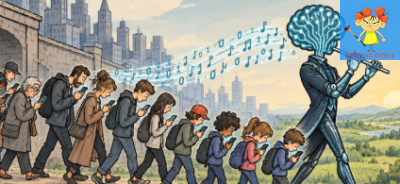
War in Real Time: Social media has turned human tragedy into an endless newsfeed for lazy scrolling. Footage of strikes, captured by the cameras of those very drones, is set to upbeat music and gathers millions of views. We use satellite internet to leave likes, argue in the comments, or engage in furious online debates about whose destruction looks more «historically justified.» The information war has turned into an interactive reality show where viewers can donate to new weapons directly through their banking apps.
The deepest paradox of this entire digital slaughterhouse is that in the race for territory, resources, or the ambitions of leaders, humanity completely ignores basic natural logic.
Yet, human life was, is, and will remain unchanged in its essence.
Its biological cycle is absolutely singular, simple, and monumental: birth and death.
Every living being comes to this world unprotected, crying out for warmth, and leaves it behind, leaving only memory.
Between these two points lies a tiny, fleeting moment intended for living, creating, and experiencing the universe.
But civilization decided that the best way to use this unique chance is to cut it short with a flying piece of metal. No system is capable of overriding the laws of nature or granting immortality, yet they easily privatized the right to interrupt this sacred, universal cycle for the sake of temporary lines in geopolitical reports.
The Verdict
From the first flint arrowhead in the Sudanese dirt to modern AI-driven drones, humanity has proven only one undeniable truth: we are incredibly smart at creating tools and astonishingly blind at managing our instincts.
We built a beautiful technological civilization only to broadcast our own destruction in high definition with maximum comfort. We can sleep soundly knowing that no matter how advanced we become, no matter what quantum technologies we invent, we will always find a reason to throw a rock at the neighbour across the river. It’s just that now, the rock costs millions of dollars, flies at the speed of sound, is guided by an algorithm, and has its own verified media account.
The utopia is built, but the prehistoric human inside us still tightly grips the club, lazily scratching his head with the screen of a brand-new smartphone.