
Don’t Wake the Councilman! Or How Kyiv’s City «Fathers» Ran from Newspaper «Sparks»
Introduction: On the Dangers of a Good Sense of Humor to the City Budget
Being a гласный (councilman) of the Kyiv City Duma at the turn of the 20th century was a respectable, lucrative business, and… extremely hazardous to one’s peace of mind.
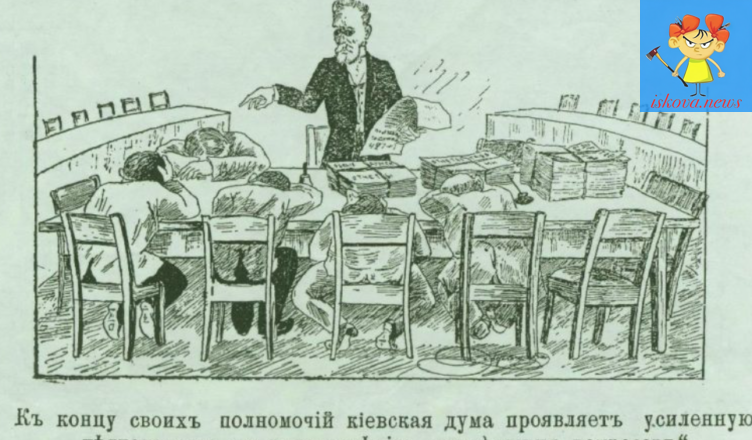
The moment a wealthy merchant of the First Guild nodded off during a monotonous presentation on kerosene procurement, the entire Khreshchatyk Street would be laughing out loud the very next morning, examining a fresh caricature.
The local press—such as the satirical weekly Kievskaya Iskra («The Kyiv Spark») or the famous liberal daily Kievskaya Mysl («The Kyiv Thought»)—had an unbearably sharp tooth for the city administration.
While the city «fathers» attempted to manage a booming metropolis with the grace of a drowsy snail, journalists and illustrators minted fortunes off their reputations.
The administration genuinely viewed this as «subversion of foundations,» but Kyivites snatched up the satirical rags faster than hot pies at Podil.
Real Case Studies: Lanterns, Horses, and the Great Quest for a Quorum
The city administration supplied journalists with plotlines with enviable regularity, completely sparing columnists the trouble of making things up.
The Bright Future Odyssey
Debates over replacing old oil lanterns with gas, and later with electricity, dragged on for decades. Newspapers pulled no punches in mocking City Mayors Vasily Protsenko and Ipolit Dyakov. Feilletons in Kievskaya Mysl regularly transformed officials into characters of a farce, pointing out that «council light» existed predominantly on paper and in expense reports, while the actual streets were swallowed by pitch darkness.
A 19th-Century Transit Collapse
When Kyiv was launching its konka (horse-drawn tram), the administration managed to draft contracts so poorly that private operators ran circles around the city. Caricatures popped up in the press showing exhausted horses riding inside the carriages, while city councilmen—led by the immensely wealthy tycoon Nikola Tereshchenko—pushed the tram from behind, hopelessly trying to catch up with technological progress.
The Hunt for Councilmen and Hallway Brawlers
The absolute biggest hit of the gossip columns was the chronic absenteeism of the deputies and their internal squabbles. Kievskaya Mysl frequently targeted Nikolai Dobrynin, a notorious councilman and landlord from Prorizna Street, who earned fame as the chief scandal-maker and «hallway agitator» during sessions. Describing how council couriers literally fished city «fathers» out of elite restaurants and merchant clubs just to assemble a quorum read like an adventure novel. Wittier journalists suggested introducing a formal police escort system to drag deputies straight to the voting hall.
The Telephone Game
When the very first telephone line was finally installed in the Duma building on Khreshchatyk, officials were terrified to approach it, viewing it as «the devil’s invention.» Newspapers reported an incident where a prominent administrative secretary spent half an hour shouting orders about road repairs into an unplugged receiver, later reporting that «the issue was resolved through the ether.» The press immediately dubbed this «a pioneering method of wireless governance without the use of intellect.»
The Mystery of the Vanishing Cobblestones
Late in the century, the Duma allocated massive funds to pave Bibikov Boulevard (now Taras Shevchenko Boulevard). Within a month, the paving stones began mysteriously disappearing, relocating… straight onto the driveways of the country villas owned by the building committee members. Journalists promptly published a «Cobblestone Guidebook,» inviting Kyivites to spot municipal property on the private estates of specific councilmen.
A Minute of Old Kyiv: Anecdotes from the Duma Corridors
The city’s urban folklore beautifully preserved the finest jokes mocking bureaucratic logic.
Anecdote No. 1: On the Speed of Decision Making
A Kyiv citizen approaches the doorman at the city administration hall and asks:
— Tell me, is it true that the city councilmen have been debating the repair of the Podil bridge for three days straight?
— Quite true, my good man. Sitting there for three days now.
— And have they finally decided when the construction begins?
— Heavens, no! So far, they’ve only decided which tavern they’ll be ordering lunches from for next week’s debates.
Anecdote No. 2: On the Municipal Budget
At a session of the Kyiv Duma finance committee, the chairman looks grimly at his ledger:
— Gentlemen, we have exactly one thousand rubles left in the city treasury. What shall we spend it on: repairing the collapsed levee or a brand-new ceremonial portrait of His Excellency the Governor for the grand hall?
The councilmen chime in unison:
— The portrait, of course! We won’t all fit under the levee anyway, but we can host plenty more gala banquets under that portrait!
Anecdote No. 3: On the Benefits of a Free Press
Two city councilmen bump into each other on Khreshchatyk. One complains bitterly:
— Did you see what Kievskaya Mysl wrote about me? They called me a thief, a bribe-taker, and claimed I sleep through sessions! I am suing them for libel!
The second shakes his head:
— Don’t you dare do that, my friend! Why go to court?
— But it’s a public disgrace!
— The real disgrace will happen when they show up in court and prove that every single word is the absolute truth!
Anecdote No. 4: On Countering Rumors
In 1890, a rumor swept through Kyiv that the bell tower of St. Andrew’s Church was on the verge of collapsing due to a landslide. Crowds of onlookers rushed to the hill. The City Duma held an emergency meeting and voted: «To allocate 500 rubles from the treasury… for an official press release denying the rumors.»
A local columnist immediately remarked: «Kyiv officials are so deeply convinced of the power of the printed word that if the mountain does collapse, they will simply ban it from doing so retroactively via a newspaper notice.»
Conclusions: The Pencil vs. The Mandate
The administration’s entire «war on satire» looked utterly ridiculous.
Kyiv’s mayors got offended, threatened lawsuits, complained fruitlessly to the Governor-General, and demanded the shutdown of «cheeky rags.»
However, the result was entirely counterproductive—a classic «Streisand effect» set in old Kyiv. Any attempt by the authorities to tighten the screws only boosted the print runs of satirical papers.
The century-old conclusion is simple: if a city administration cannot fix potholed roads or turn on streetlights on time, it has to live with being dragged through the mud on the pages of the morning paper.
More than a century has passed, and Kyiv has changed beyond recognition.
Yet one thing remains beautifully intact: the moment city officials start acting untouchable and arguing over trivialities, Kyivites immediately pull out their ultimate weapon—irony.
Last Updated on 08.11.2026 by iskova