
UNESCO: Global Impunity Level for Murder of Journalists Rises. Voices They Tried to Silence. Ukrainian Media Professionals in Russian Captivity
Six out of seven murders of journalists go unpunished—progress against impunity reversed, UNESCO, November 2, 2026.
According to a new UNESCO report, the global impunity level for the murder of journalists has risen for the first time since 2012, when the Organization began tracking this indicator. In 2024–2025, it reached 86% compared to 85% in the previous two-year period.
This trend is worsened by another finding in the report: 189 journalists were killed in 2024 and 2025—a 20% increase compared to the previous two-year period. More than two-thirds of them (127 people) died in armed conflict zones.
The UNESCO Director-General’s Report on the Safety of Journalists and the Danger of Impunity is published every two years on the occasion of the International Day to End Impunity for Crimes against Journalists.
«Journalists are increasingly paying with their lives for covering events on the front lines of armed conflicts, and those responsible for their murders too often go unpunished. I call once again for compliance with UN Security Council Resolution 2222, unanimously adopted in 2015. It provides for the protection of journalists, media workers, and associated personnel as civilians in armed conflict situations. This status is also reaffirmed in the Pact for the Future,» said Khaled El-Anany, Director-General of UNESCO.
New military technologies pose additional threats to journalists in conflict zones.
The report identifies an alarming new threat: the increasing use of unmanned aerial vehicles (UAVs), or drones, to kill journalists.
During 2024–2025, drone strikes killed 50 journalists—accounting for 40% of the total number of journalists killed in armed conflict zones.
UNESCO also documented seven cases where multiple journalists were targeted and killed in a single attack, including strikes on media offices and temporary media working hubs.
According to reports, 15 journalists died while wearing «Press» vests or riding in vehicles clearly marked «Press.»
Signs of progress: in countries not affected by armed conflict, the impunity rate fell to 77%
The report’s findings show significant differences between trends in countries affected by armed conflict and those without such conflicts.
Despite the worsening global situation, the impunity rate in countries not affected by armed conflict continues to decrease consistently: from 94% in 2012 to 77% in 2026, meaning an average of one percentage point annually.
The number of journalist killings in countries unaffected by armed conflict also decreased, totaling 85 cases—the lowest figure in the past 18 years. This shows that progress is possible when governments invest resources in investigating crimes, holding perpetrators accountable, and ensuring the protection of journalists.
Women journalists face specific risks both in conflict zones and online.
Out of the 14 women journalists killed in 2024–2025, 93% died while covering armed conflicts. Although women make up a relatively small percentage of killed journalists, they continue to face a disproportionately high level of abuse and harassment both online and offline.
According to a 2025 study by UN Women and the International Center for Journalists (ICFJ), 75% of women journalists have encountered such forms of violence and harassment.
The study also revealed a significant increase in the number of women reporting that online violence led to offline violence or harassment: compared to a previous UNESCO study conducted in 2020, this figure more than doubled—from 20% to over 40% in 2025.
About UNESCO (Brief, clear, understandable)
UNESCO is a specialized agency of the United Nations whose mandate includes promoting freedom of expression, press freedom, and ensuring the safety of journalists.
The UNESCO Director-General’s Report on the Safety of Journalists and the Danger of Impunity is published every two years on the occasion of the International Day to End Impunity for Crimes against Journalists and is presented at the session of the Intergovernmental Council of the International Programme for the Development of Communication (IPDC).
During the session, member states assess the global situation and discuss current challenges related to ensuring the safety of journalists and fighting impunity.
The United Nations Educational, Scientific and Cultural Organization, which comprises 194 member states, promotes peace and brings nations closer together by leading multilateral cooperation in education, science, culture, communication, and information.
UNESCO’s headquarters are located in Paris, and the Organization’s offices operate in 53 countries.
UNESCO coordinates a network of over 2,260 World Heritage sites, biosphere reserves, and global geoparks; a network of more than 1,500 creative, learning, inclusive, and sustainable cities; over 13,000 associated schools, university chairs, training, and research institutions, and brings together 200 national commissions.
The Director-General of UNESCO is Khaled El-Anany.
«Since wars begin in the minds of men, it is in the minds of men that the defenses of peace must be constructed,»—UNESCO Constitution, 1945.
The UNESCO report emphasizes that the majority of journalists today die in armed conflict zones.
But while in previous years media workers were more often accidental victims of crossfire, in Ukraine they have turned into priority targets.
The hunt for independent witnesses is conducted both on the front lines and deep in the rear.
The Price of Truth: Fallen Foreign Reporters and Media Workers in Captivity
Since the beginning of Russia’s full-scale invasion of Ukraine (from February 24, 2022), at least 144 media workers have died, according to official monitoring by the Institute of Mass Information (IMI). If looking at the data of the National Union of Journalists of Ukraine (NUJU), this figure exceeds 160 people.
Targets of War: Stories of Those Who Died and Were Captivated for the Truth
Losses among media workers are divided into three main categories:
In the line of duty: 15 reporters and camera operators (both Ukrainian and foreign) died while documenting events on the front lines or falling under targeted shelling.
In the ranks of the Armed Forces of Ukraine: More than 105–130 media employees changed their profession, mobilized, and died directly in the course of combat actions as combatants.
Civilian victims: Media workers killed as a result of indiscriminate Russian missile strikes and drone attacks on peaceful cities in the rear.
Fallen Foreign Journalists
During the full-scale invasion, while performing professional duties on the front line and in frontline zones, at least 10 foreign media workers died.
Here are the stories of some of them:
Brent Renaud, USA
Who he was: Renowned documentary filmmaker, Peabody Award winner, who worked in hot spots around the world (Iraq, Afghanistan).
Story of his death: Became the first foreign journalist to die after February 24, 2022. Brent was gathering material about refugees for a TIME Studios project. On March 13, 2022, in Irpin (Kyiv region), Russian military forces opened fire on a vehicle Renaud was riding in. He received a fatal wound to the neck.
Pierre Zakrzewski, Ireland
Who he was: Experienced war photojournalist for Fox News channel, who covered conflicts in Syria, Libya, and Afghanistan.
Story of his death: On the day following Renaud’s death, March 14, 2022, a vehicle carrying a Fox News camera crew came under artillery shelling by Russian troops in the village of Horenka near Kyiv. Together with Pierre, a young Ukrainian fixer and journalist, Oleksandra Kuvshynova, was killed.
Arman Soldin, France
Who he was: Video coordinator for the Agence France-Presse (AFP) news agency in Ukraine.
Story of his death: On May 9, 2023, a group of journalists along with Ukrainian military personnel came under fire from Grad rocket artillery systems near Chasiv Yar (Donetsk region). Arman died instantly; the other members of the team were unharmed.
Ryan Evans, United Kingdom
Who he was: Safety advisor for Reuters news agency, a former British soldier who provided protection for journalists on the front lines.
Story of his death: Killed on August 24, 2024, as a result of a targeted missile strike (presumably an Iskander-M) on the Sapphire Hotel in Kramatorsk, where the camera crew was based. Several other Reuters journalists sustained severe injuries.
Antoine Lallican, France
Who he was: Freelance photojournalist documenting the consequences of the war.
Story of his death: Killed on October 3, 2025, on the front line by a targeted strike from a Russian FPV drone, despite wearing protective gear clearly marked «PRESS.» Ukrainian photographer Hryhoriy Ivanchenko, who was working with him, was wounded.
Other fallen foreign journalists include documentary filmmaker Mantas Kvedaravičius (Lithuania, shot in Mariupol), Frédéric Leclerc-Imhoff (France, killed near Luhansk during the shelling of an evacuation convoy), and Oksana Baulina (Russia, independent outlet The Insider, killed under shelling in Kyiv).
Ukrainian Media Professionals in Russian Captivity
The Russian Federation systematically employs the practice of taking civilian hostages, among whom journalists constitute a key category due to their professional activities in the occupied territories.
As of November 2026:
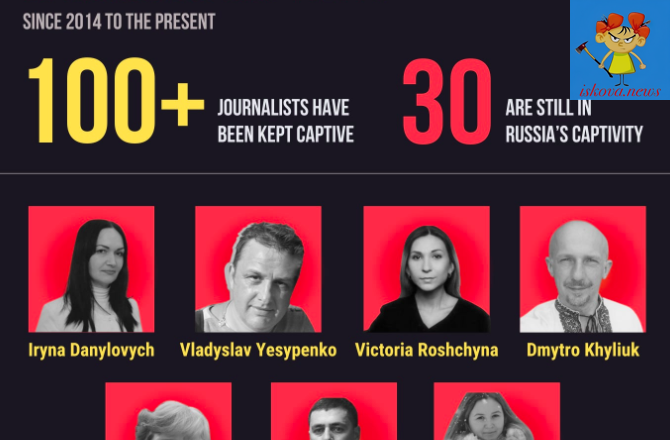
At least 27–28 Ukrainian media workers and civilian journalists are being held in captivity. Of these, 27 are civilian journalists, bloggers, and fixers, and at least one is a media representative captured while serving as a member of the Armed Forces of Ukraine.
Geography: Around 17 of those held are Crimean Tatar civilian journalists from occupied Crimea (mostly collaborating with the «Crimean Solidarity» initiative) who were arrested on fabricated «terrorism» charges even prior to 2022. The rest were abducted in the newly occupied areas of Zaporizhzhia, Kherson, and Luhansk regions.
Status: The majority are held in pre-trial detention centers (SIZO) and penal colonies within the Russian Federation without any contact with the outside world. The International Committee of the Red Cross (ICRC) has officially confirmed the detention status of only one out of the 26+ captive journalists.
Key and High-Profile Names Among the Captives:
Vladyslav Yesypenko – a journalist for Radio Free Europe/Radio Liberty (Crimea.Realities project), detained in Crimea in 2021.
Iryna Danylovych – a civilian journalist and human rights defender from Crimea. While in detention, she has nearly lost her hearing due to the denial of medical care.
Server Mustafayev – coordinator of «Crimean Solidarity,» sentenced by Russia to 14 years in a high-security penal colony.
Anastasia Hlukhovska and Iryna Levchenko – journalists abducted in occupied Melitopol.
Tragic precedent: In September 2024, 27-year-old Ukrainian journalist Viktoria Roshchyna died in Russian captivity while being transferred to Moscow to be included in a prisoner exchange list. She had gone missing in August 2023 while preparing a report in the occupied territory.
Conclusion
The war in Ukraine has clearly demonstrated that modern war crimes include the systematic destruction of freedom of speech.
The deaths of foreign reporters targeted on the front lines and dozens of Ukrainian journalists held for years in Russian prisons without the right to defense are not accidental collateral damage.
This is a deliberate campaign to eliminate independent witnesses.
In an environment where the global level of impunity for crimes against the press continues to rise, the case of Ukraine demands that the international community establish fundamentally new mechanisms for protecting journalists and pursue strict legal prosecution of those who order forces to open fire on individuals wearing «PRESS» insignia.
Last Updated on 05.11.2026 by iskova