
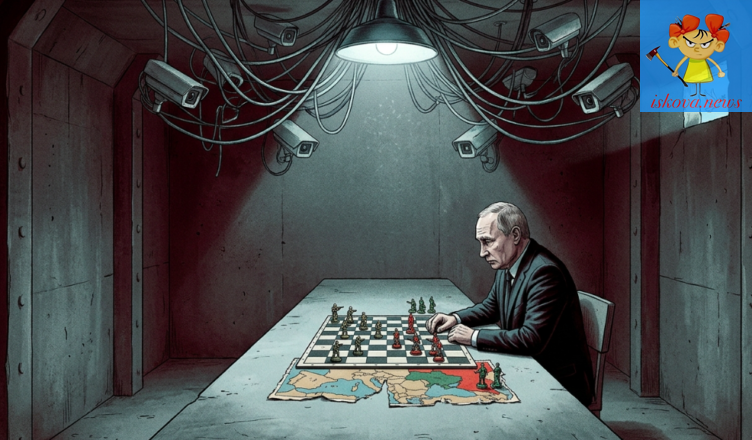
Inside the bunker
How isolation, intelligence habits and sunk costs trap Vladimir Putin in a forever war
To understand why the Kremlin continues to prosecute a ruinous war in Ukraine, looking solely at maps, balance sheets or military hardware is not enough.
Political psychologists, intelligence historians and Kremlin-watchers increasingly look inside the mind of Vladimir Putin—and at the institutional architecture he has built around himself.
Over more than a quarter-century in power, a former intelligence officer has constructed an echo chamber that distorts reality, amplifies paranoia and makes backing down look more dangerous than pressing on.
Five overlapping pathologies explain how the Kremlin thinks—and why diplomacy remains deadlocked.
The first is the tradecraft of the KGB. As Andrei Soldatov and Irina Borogan, historians of Russia’s security services, have documented, intelligence training instils a worldview in which spontaneity does not exist.
Mass protests, from the «colour revolutions» to Ukraine’s Maidan, are never seen as genuine expressions of popular will; they are invariably interpreted as covert operations orchestrated by Western spy agencies.
That reflex breeds an incurable suspicion of democratic politics and a tendency to spot existential plots everywhere.
Second comes the information cocoon. Autocrats who rule for decades rarely hear bad news, and Mr Putin is no exception.
Political scientists such as Ekaterina Schulmann and Brian Taylor note that as the Russian state grew more centralised—and as pandemic-era biosecurity protocols dramatically shrank the ruler’s inner circle—the feedback loops collapsed. Subordinates tell the boss what he wants to hear. The result was a catastrophic misreading of both the Russian army’s readiness and Ukraine’s capacity to resist.
Third is an abstract relationship with violence. Unlike leaders forged in the trenches, Mr Putin has never experienced combat firsthand. To a ruler who knows war only through staff maps and sanitised briefings, territory becomes a chessboard and casualties mere entries on a ledger.
Fourth is what Jerrold Post, a pioneer of political psychology, termed «late-reign syndrome». Unconstrained by term limits and acutely aware of his own mortality, an ageing autocrat becomes obsessed with his chapter in the history books. Restoring lost imperial domains takes on the aura of a sacred mission, dwarfing mundane concerns such as economic stagnation or demographic decline.
Finally, there is the sunk-cost fallacy. Having staked his legitimacy, Russia’s economy and tens of thousands of lives on the invasion, Mr Putin cannot admit error without jeopardising his own political survival. In cognitive psychology, this is known as «escalation of commitment»: when the price of failure becomes unbearable, the gambler doubles his bet.
Three lenses on a stalemate
To grasp why this mindset is so hard to dislodge, it helps to view the crisis through three distinct lenses:
-
- The psychological: Prolonged personalist rule erases the boundary between the leader and the state. A threat to Mr Putin’s grip on power is treated as a mortal threat to Russia itself, justifying pre-emptive aggression.
- The historical: Individual neuroses sit atop deep post-imperial resentment. Historians such as Timothy Snyder and Serhii Plokhy argue that Moscow’s refusal to accept the settlement of 1991 reflects an older imperial logic: an independent, democratic Ukraine is viewed as a standing rebuke to Russia’s own autocratic model.
- The diplomatic: By 2022 the guardrails of the Cold War—arms-control treaties and crisis hotlines—had largely rusted away. In a vacuum of trust, coercion displaced compromise.
Searching for an exit
If the war is driven in part by the psychology of one isolated man, can it end while he remains in the Kremlin?
Specialists in conflict resolution doubt that Mr Putin will ever experience a sudden change of heart. Instead, they point to structural shifts that could force a reckoning: resource exhaustion, a quiet revolt among nervous elites whose wealth and security are imperilled, or an external security architecture robust enough to deter future adventures regardless of who sits in Moscow.
A rapid breakthrough remains unlikely precisely because the two sides value time differently. So long as the Kremlin believes it can outlast Western resolve, it has little reason to compromise. A swift exit would require either an off-ramp that lets Mr Putin claim victory at home, a sudden economic or battlefield shock, or an abrupt leadership transition in which successors blame the war on the old regime.
Four ways to break the deadlock
Ordinary people want peace and safety, yet diplomats warn that a flimsy piece of paper without teeth would merely buy Russia time to rearm.
Drawing on past frozen conflicts, strategists outline four practical mechanisms to stop the killing without capitulating:
-
- Decouple the ceasefire from politics. Halt the fighting along the current front line without legally recognising Russia’s conquests. Defer territorial disputes for decades—as on the Korean peninsula or in Cyprus—under strict international monitoring.
- Trade a freeze for hard security. Ensure that missiles do not rain on Ukrainian cities again by extending credible defence guarantees to Kyiv-controlled territory. That could mean NATO membership on the 1955 West German model—covering only the free part of the country—or ironclad bilateral defence pacts backed by foreign troops.
- Make sanctions relief reversible. Lift economic penalties only incrementally, tied to verified compliance: silence on the front lines, the pullback of heavy weapons and the return of prisoners and deported children. Any breach should trigger an automatic snapback.
- Raise the cost of fighting. Serious talks begin only when continuing the war becomes demonstrably more expensive for the aggressor than stopping it. That requires tighter air defences for Ukraine and relentless pressure on Russia’s war economy.
Ultimately, peace will not come from psychoanalysing the man in the bunker or persuading him to change his mind. It will come only when the outside world constructs a reality in which renewed aggression is guaranteed to fail.
Last Updated on 30.11.2026 by iskova